
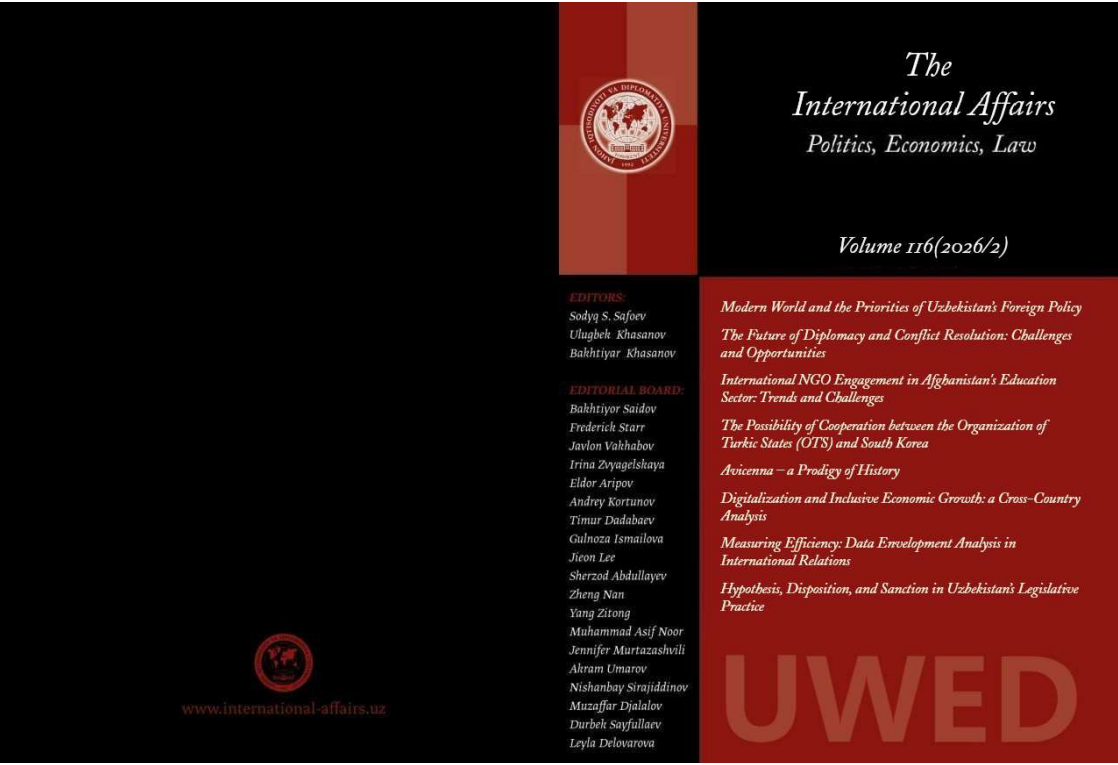
 08 April 2026
 ABDUL SABOOR NOORI
 303
303
 344
344
 0
0
 Share
Share
 Download
Abstract:
Since the political transition in August 2021, Afghanistan's education sector has faced an unprecedented crisis characterized by restrictive policies, funding deficits, and shrinking operational space for humanitarian actors. This article examines the evolving role of international non-governmental organizations (NGOs) in sustaining educational access amid these challenges, which directly impacts overall security in Afghanistan and regional stability.
Drawing on document analysis of Scopus-indexed literature, recent field reports from UNESCO and UNICEF, and stakeholder interviews, the study analyzes shifting trends in NGO involvement from 2001 to 2024. Main findings reveal that while international NGOs successfully established a parallel infrastructure for community-based education (CBE) reaching over 1 million children, post-2021 realities severely constrained their operational capacity. Bans on secondary education for girls forced NGOs to pivot toward primary-level support, digital learning alternatives, and local teacher training.
However, these efforts are undermined by declining international aid, coordination deficits, and mounting bureaucratic hurdles imposed by de facto authorities. Utilizing interdisciplinary scientific research, the paper argues that safeguarding educational gains requires a strategic shift toward localized partnerships, adaptive programming, and protection mechanisms for female educators. These findings offer actionable insights for education in other fragile and conflict-affected contexts.
Keywords: NGO involvement, education in Afghanistan, humanitarian aid, community-based education, girls' education, education in emergencies, security in Afghanistan, interdisciplinary scientific research.