About
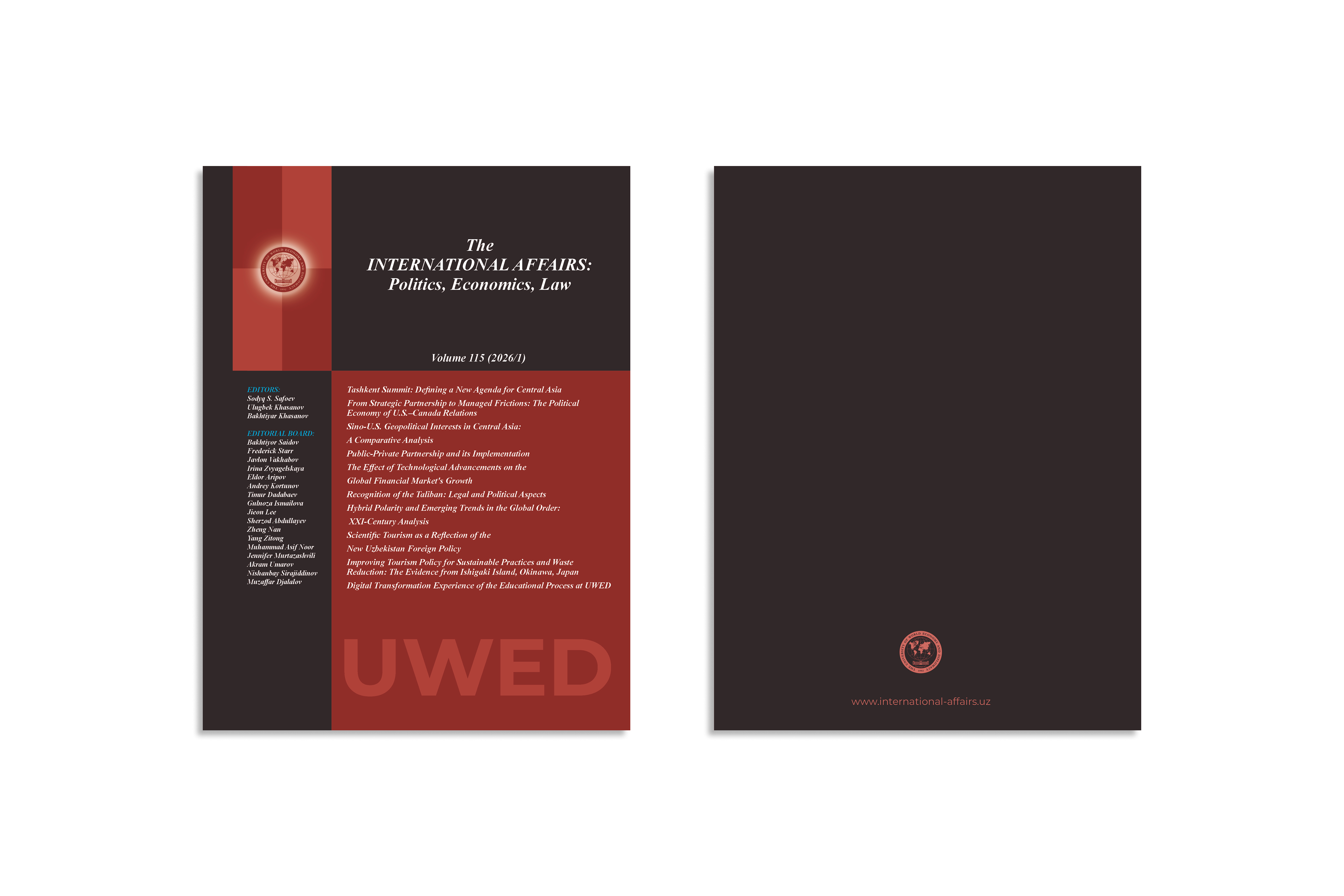
About the Scientific Journal: Platform for Research in International Politics, Economics, and Law
Scientific publications in economics and law play a pivotal role in advancing the academic environment, deepening interdisciplinary integration, and fostering professional dialogue among international researchers. As a leading scientific journal international relations in Uzbekistan, this publication dedicated to international politics, economics, and law serves as an open, multifunctional platform for knowledge exchange, global process analysis, and the presentation of high-impact research results.
The journal is oriented toward authors interested in how to publish an article in political science, economics, and law, as well as presenting timely, theoretically grounded, and policy-relevant scientific papers. Our peer-reviewed journal Tashkent creates ideal conditions for professional interaction among scholars, policy analysts, professors, diplomats, and practitioners working in international relations and allied disciplines. We foster scientific dialogue on international processes and innovative knowledge sharing as primary drivers for comprehending and navigating rapid transformations within the global community.
Scope and Key Thematic Focus
The journal specializes in publishing scholarly materials reflecting contemporary trends, structural transformations, and security challenges in Eurasian and global studies. Special emphasis is placed on an interdisciplinary approach, allowing researchers to examine complex global and regional dynamics from multiple analytical angles and at the intersection of various scientific fields.
Core thematic focus areas and research priorities include:
-
International politics, global security architecture, foreign policy of Uzbekistan 2026, Uzbekistan development strategy until 2030, and diplomacy of New Uzbekistan;
-
Geopolitics of Central Asia analysis, regional security in Central Asia, water diplomacy in Central Asia, and ecological security of the Aral Sea;
-
World and regional economics, economic diplomacy of Uzbekistan, investment climate in Uzbekistan 2026, digital economy in international relations, and political economy of international relations;
-
Eurasian transport corridors, Eurasian economic integration, multimodal logistics infrastructure, and global trade transformations;
-
International and comparative law, legal reforms in New Uzbekistan, international law in Central Asia, and international legal regulation;
-
Foreign policy of states, subregional integration processes, and multilateral organizations including Uzbekistan role in the SCO, CIS integration processes, UN partnerships, and Uzbekistan collaboration with the European Union;
-
Economic and legal aspects of international cooperation, bilateral strategic partnerships including Uzbekistan Russia relations and Uzbekistan China trade relations;
-
Regional energy diplomacy, migration policy in the region, cultural diplomacy and soft power, and counter-terrorism in Central Asia;
-
Tashkent summit outcomes, history of Uzbekistan diplomacy, Tashkent foreign policy analytics, and strategic decision-making frameworks.
The journal focus reflects current issues in the modern world and actively contributes to shaping high-level academic discussions on an international scale.
Scientific Journal in Uzbekistan: Academic Standards and Quality
As an authoritative VAK journal Uzbekistan international relations, economics, and law, the publication adheres strictly to internationally accepted standards of publication ethics and rigorous scientific expertise. All submitted manuscripts undergo a mandatory review process in accordance with higher attestation standards to ensure the high quality of published papers.
Core operational principles of the journal include:
-
Independent scientific expertise and academic evaluation of the article;
-
Objective evaluation of submitted research materials;
-
Strict adherence to publication ethics and intellectual property protection;
-
Transparency, fairness, and clarity in editorial workflows;
-
Uncompromising commitment to research quality, timeliness, and scientific novelty.
The editorial board consists of leading scholars, professors, and recognized experts in international politics, global economics, and law, enabling a professional evaluation of every manuscript and providing constructive guidance for authors.
Institutional Partnerships and Academic Links
The operational success of the journal is reinforced by a broad network of academic and institutional partnerships. The journal collaborates actively with leading higher education institutions, scientific research institutes, think tanks, and international bodies across Uzbekistan and abroad. Key institutional partners include the University of World Economy and Diplomacy, the Information Analytical Center for International Relations, and allied research platforms.
Institutional partnerships ensure that published articles possess not only theoretical significance but also serve as analytical resources for diplomatic and economic policy decisions.
International Politics, Economics, and Law as an Integrated Research Space
Contemporary international processes cannot be effectively analyzed within the boundaries of a single academic discipline. For this reason, the journal treats international politics, economics, and law as interconnected elements of a unified global system and an integrated research space.
This comprehensive perspective enables scholars to:
-
Gain deeper analytical insights into the root causes of international conflicts and cooperative mechanisms;
-
Evaluate the impact of macroeconomic trends on state foreign policy trajectories and geopolitical shifts;
-
Examine the evolution of legal instruments governing contemporary international relations and institutional reforms;
-
Construct comprehensive models for understanding complex global realignments.
By encouraging interdisciplinary scientific research, the journal remains highly sought after by a broad community of academic scholars, analysts, and policy experts.
For Reviewers: Review Criteria and Standards
To maintain high academic standards, all submitted manuscripts undergo independent double-blind peer review, ensuring that author and reviewer identities remain anonymous throughout the process. Reviewers assess submitted manuscripts based on methodological rigor, analytical depth, and compliance with academic writing style.
Archives and Recent Issues
The publication adheres to open access principles. In the archives of International Relations journal section, full-text access is provided to all back issues published since the journal's inception. The Recent Issues section features newly released articles, each assigned a unique DOI to facilitate global citation.
Author Opportunities: How to Submit Your Research
If you are looking to submit an article to an international journal, our publication provides researchers with a streamlined avenue to publish their original work. The journal serves as a reliable platform both as a dedicated publication for doctoral students and master's candidates and for seasoned academic experts.
The publication process includes:
-
Submitting manuscripts through the established editorial format via the website portal or official email;
-
Initial screening for scope relevance and requirements for formatting scientific articles;
-
Rigorous peer review and objective academic evaluation;
-
Editorial revisions and refinement when necessary;
-
Publication of the final article in print and digital open-access formats;
-
No publication fees or peer review charges are imposed on authors.
Value of the Journal for the Scientific Community
The journal plays a vital role in advancing scientific discourse both within Uzbekistan and internationally. Published papers facilitate the dissemination of innovative research ideas, support expert policy evaluations, and strengthen international academic collaboration.
Modern Format, Digital Accessibility, and Contact Details
Embracing modern digital tools, the journal ensures reliable and open access to its content for readers and contributors worldwide. The digital format accelerates publication cycles, expands contributor geography, and fosters rapid knowledge exchange among specialists.
For inquiries regarding manuscript submission, editorial guidelines, or institutional collaboration, please reach out through our Contact section, where you will find full address details, official email addresses, and contact phone numbers.